 Midnight Alibi
Midnight Alibi / How to play
How to play
Every case is a small logic puzzle with a murder at its center. This page covers everything from your first Easy case to Expert.
-
01
The timeline
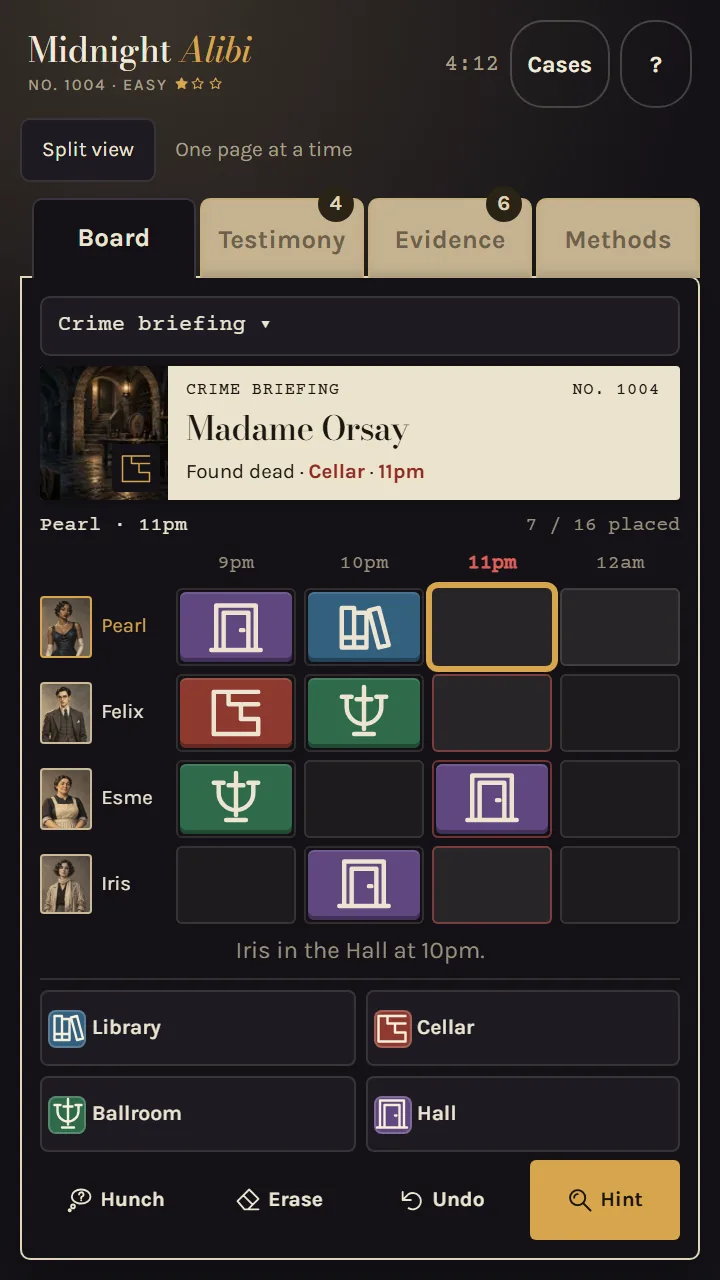
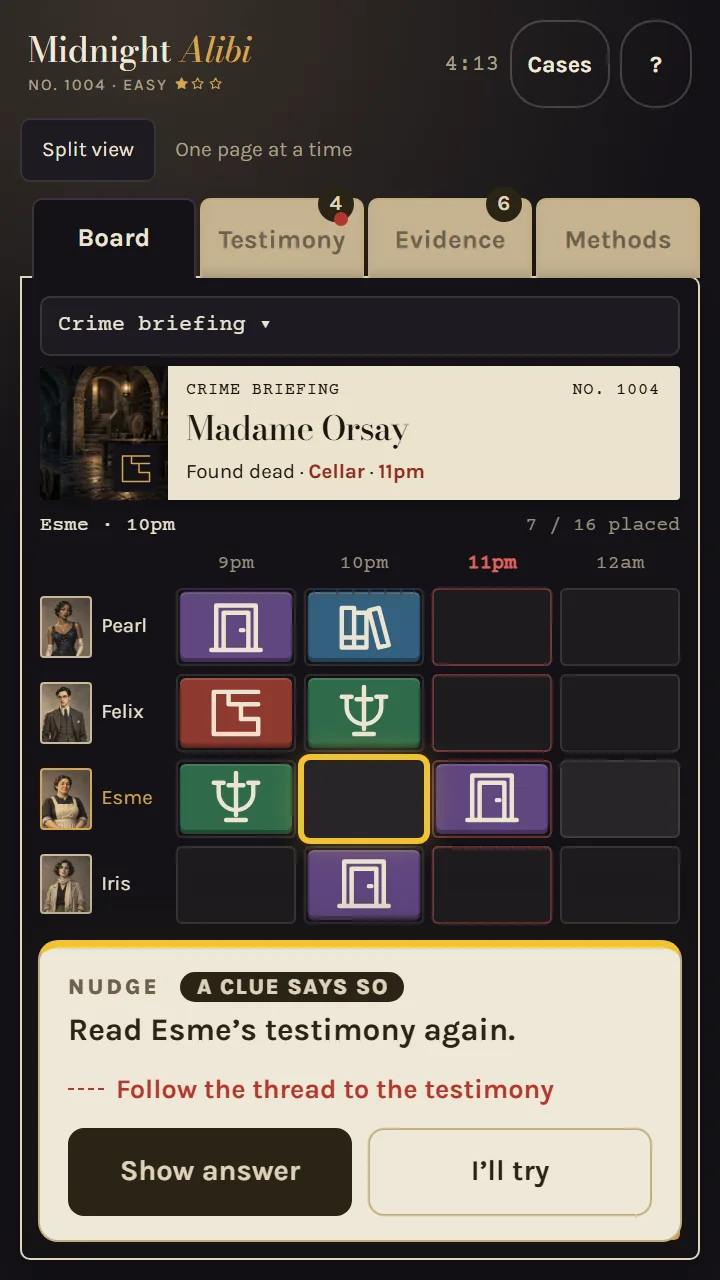
The Board is a grid. Each row is a suspect, each column is an hour, and each square is the room that suspect was in.
Like a Sudoku, every suspect visits every room exactly once, and no two suspects share a room at the same hour. Tap a square, then pick a room.
-
02
Testimony and evidence
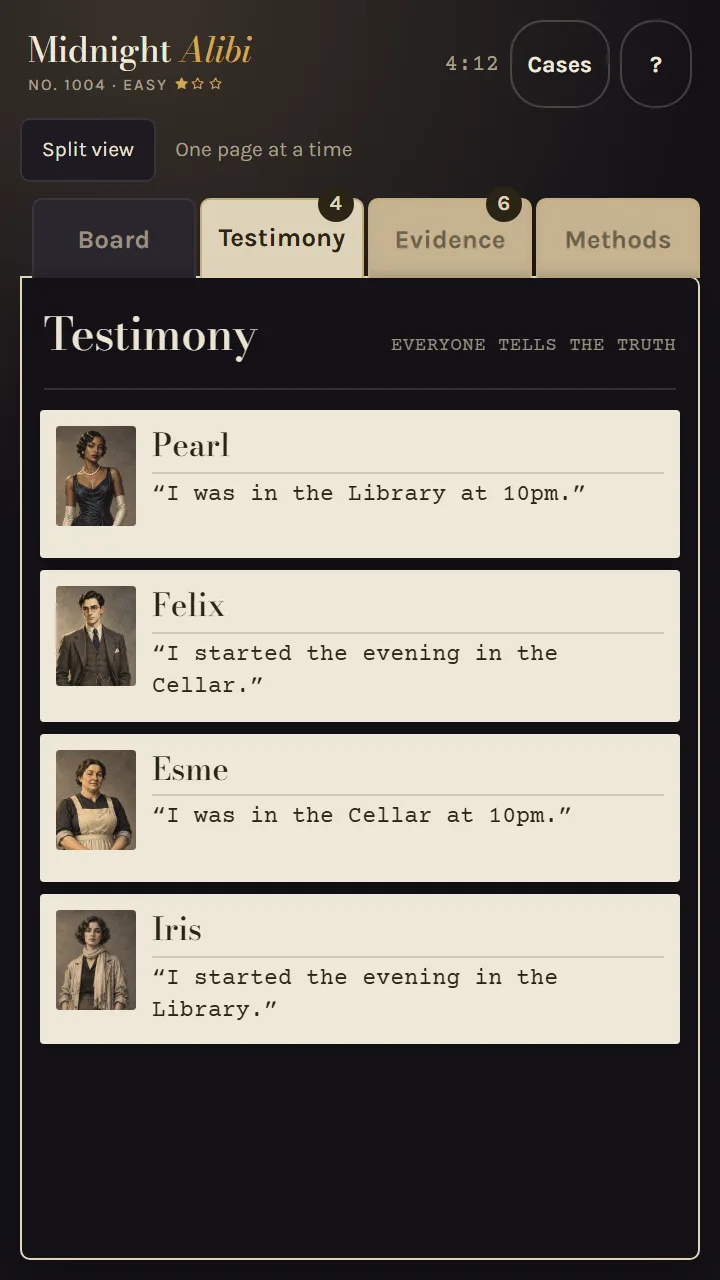
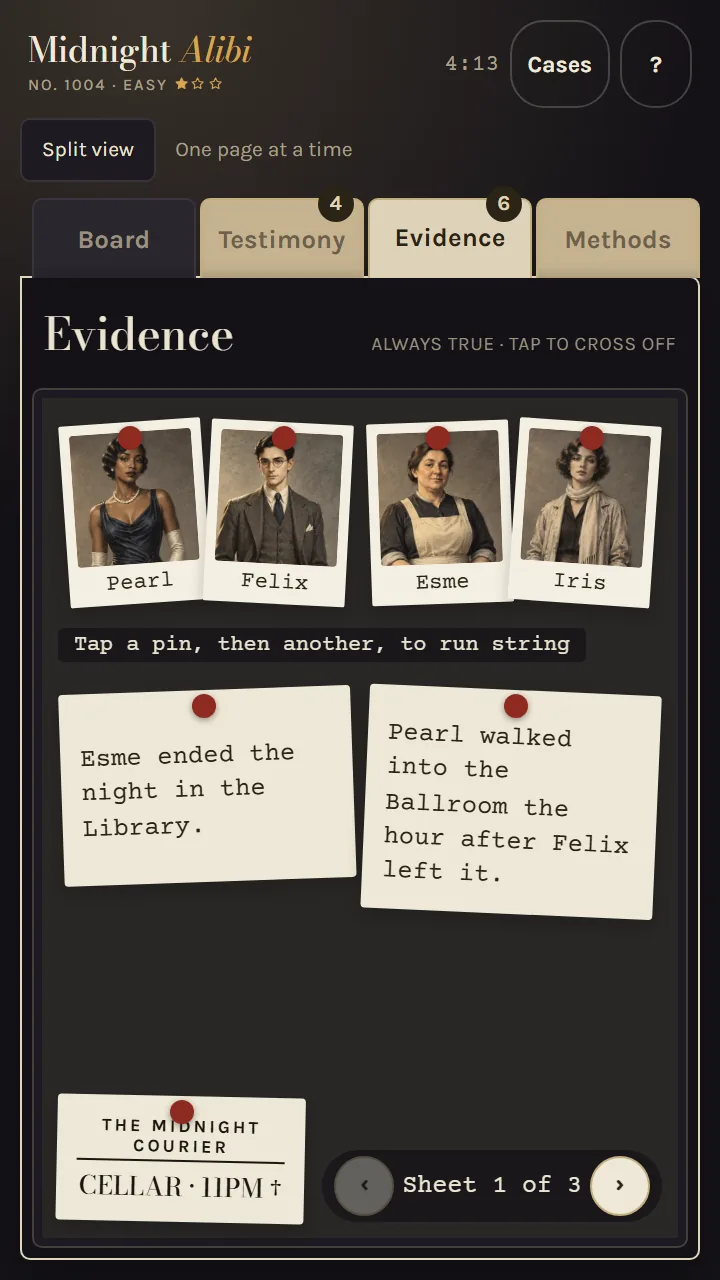
The Testimony tab has one statement from each suspect. The Evidence corkboard holds what forensics found, and evidence is always true.
Tap a statement to cross it off once you have used it. On the corkboard, tap one pin and then another to run red string between clues.
-
03
The accusation
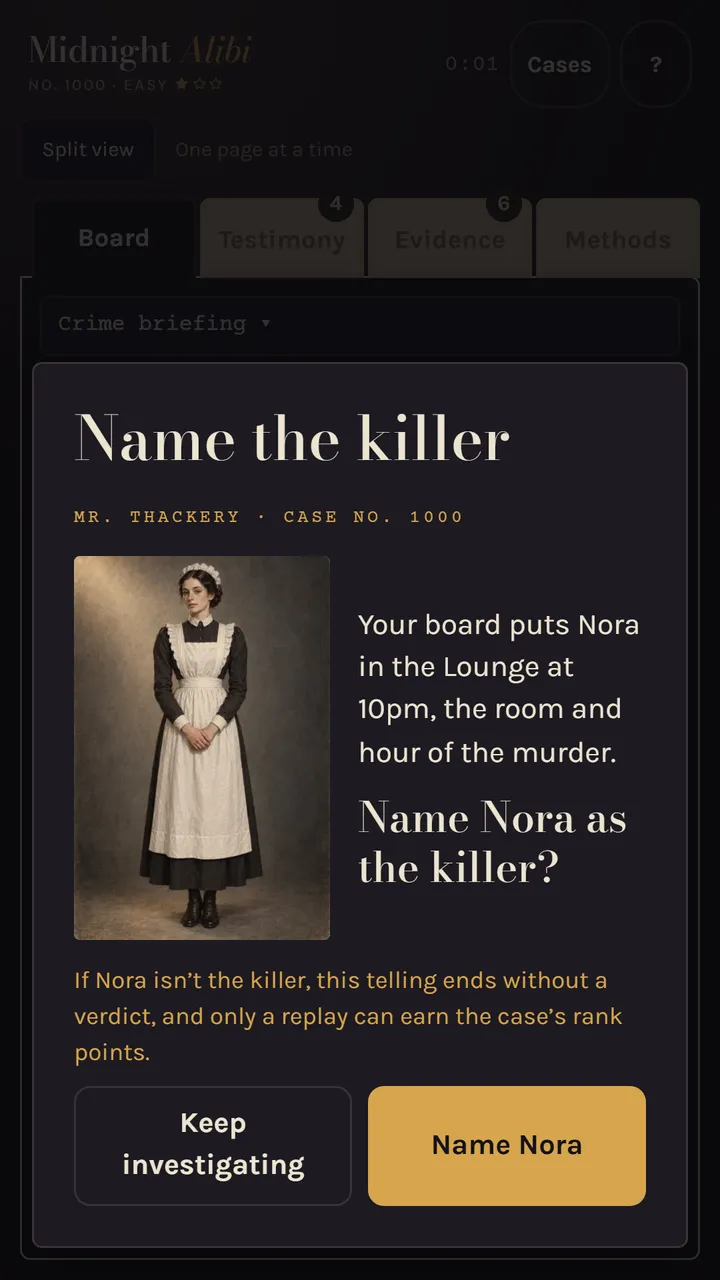
The body was found in one room at the time of death. Whoever was in that room then is the killer. As soon as someone is placed at the scene at that hour, the Accuse button appears, so you don’t have to finish the whole board. Accuse shows the suspect your board puts there and asks before naming them. Be sure: a wrong accusation ends that telling of the case without a verdict, and only a replay with new names and rooms can still earn its rank points.
On Hard and Expert, the killer’s testimony is a lie. Find the statement that can’t be true.
When you’re stuck
Help that teaches
Hint
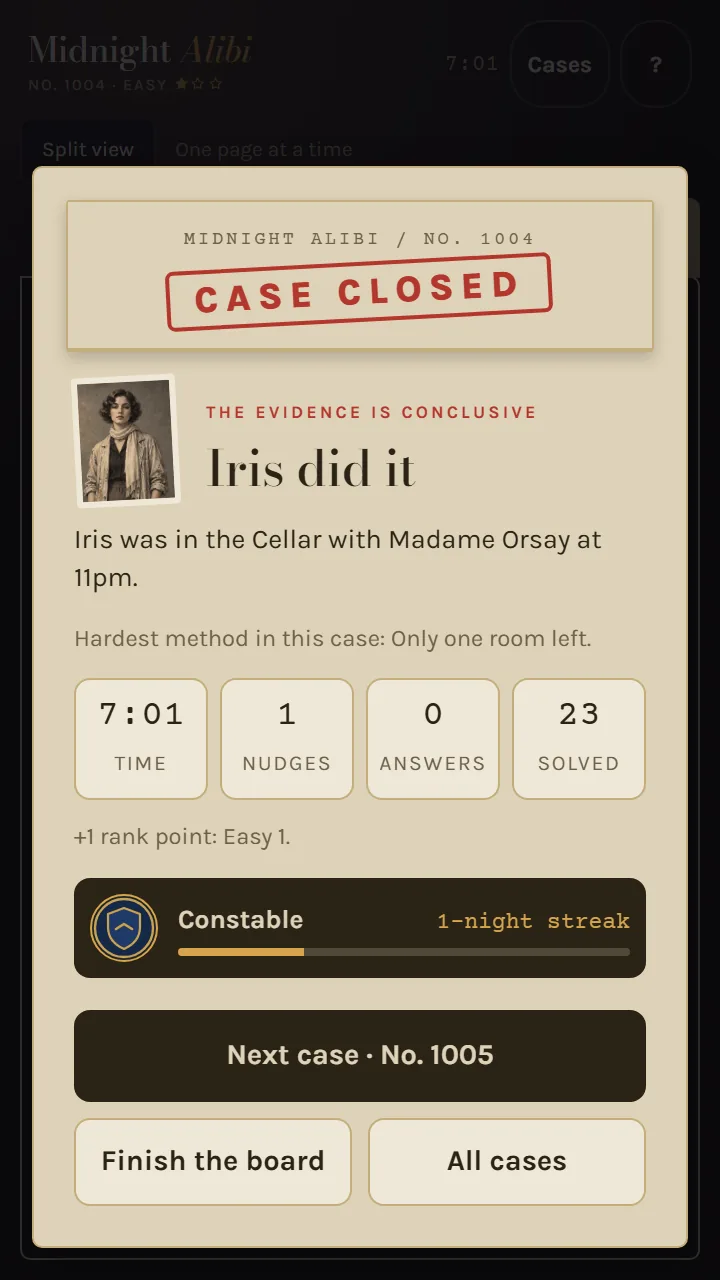
A nudge comes first. It names the method and points at the right square. Tap Show answer to see the answer, with every step explained. Each answer costs the case a rank point, though a solved case always earns at least one.
Check your work
If a square you placed doesn’t fit the clues, the hint outlines it in red. Show answer clears it so you can work it out again.
Hunch
Pencil in the rooms a square might be: tap a room once for a maybe, twice to rule it out, and a third time to clear it. When you place a room, it is removed from the maybes in the rest of that row and hour.
Methods
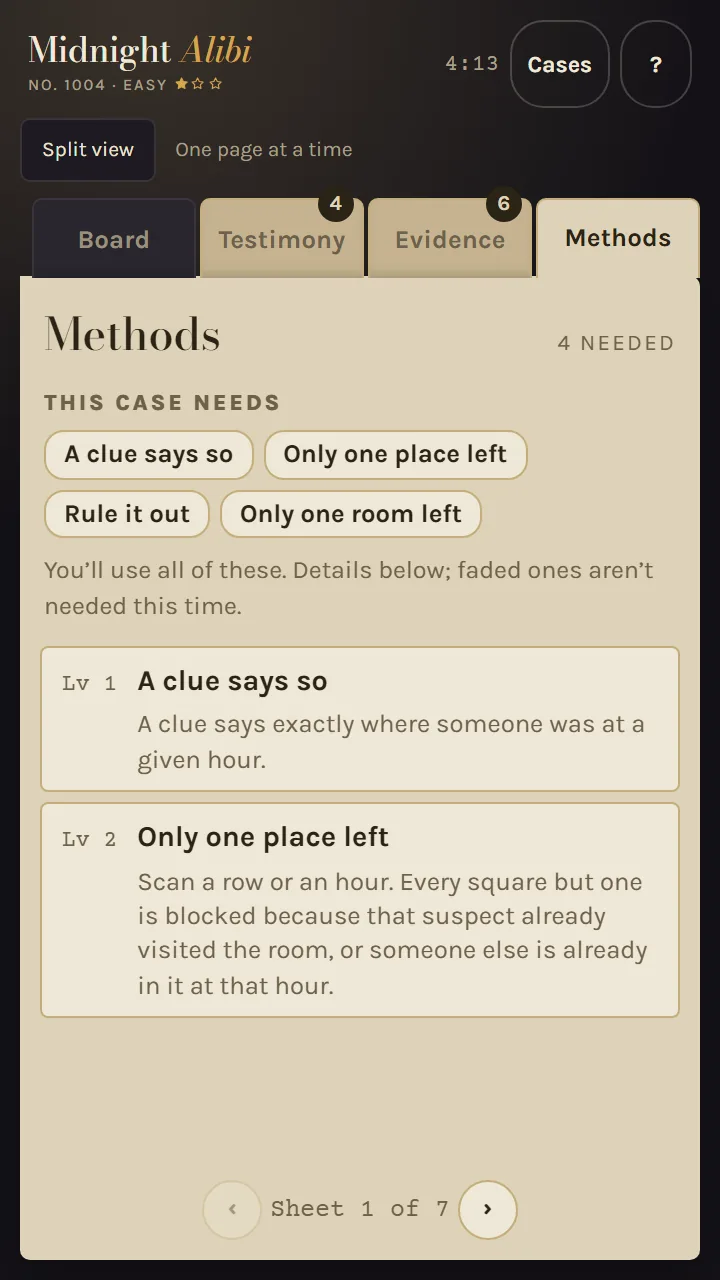
Each case lists the methods it needs, so you know what to look for before you start.
Four levels
Graded by the hardest method a case needs
| Level | Suspects | A liar | Methods | Opens |
|---|---|---|---|---|
| Easy | 4 | No | Direct statements, ruling rooms out, only one place or room left. Extra clues help you start. | From the start |
| Medium | 5 | No | Adds pairs: two rooms locked into two squares. | From the start |
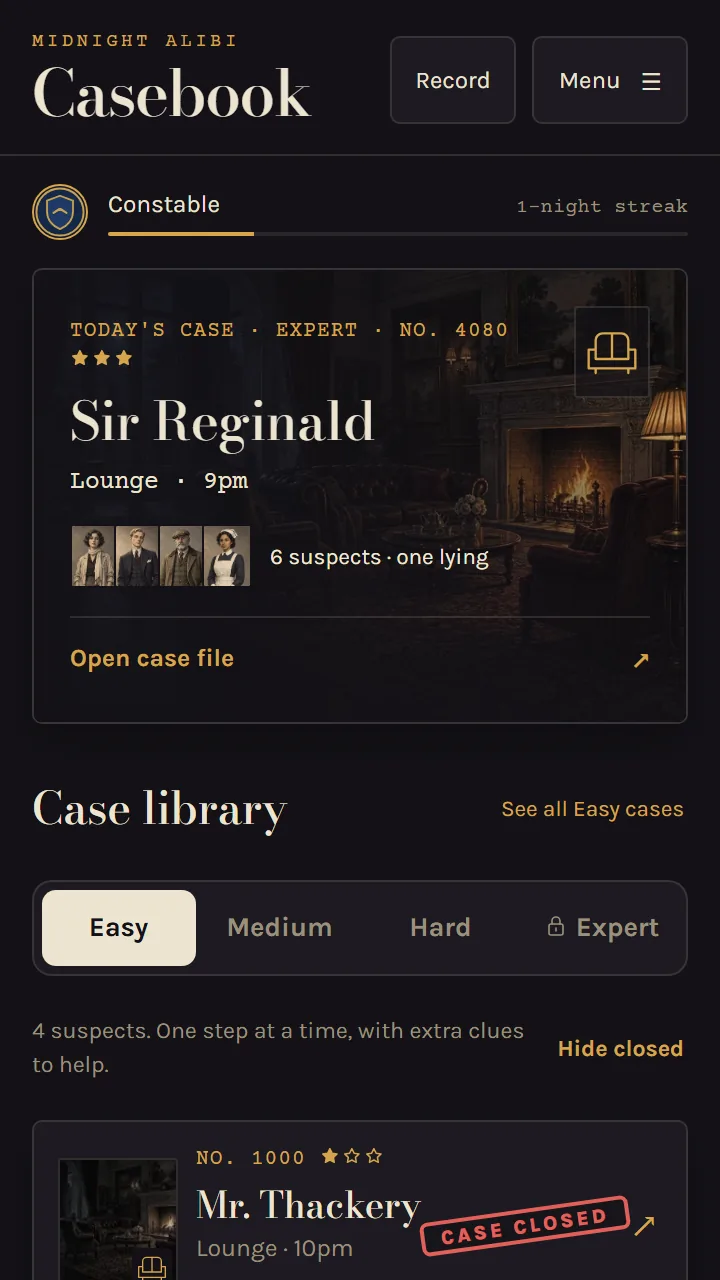
| Hard | 5 | Yes, the killer lies | Adds catching the liar, cross-checking two rows and chains of three. | At Amateur Sleuth |
| Expert | 6 | Yes, the killer lies | Needs cross-checks or harder, up to three-row cross-checks. | At Investigator |
Today’s case is always open, whatever its level. Case Files: Volume 1 adds cases to every level, and Hard and Expert still open with rank.
The methods
The eleven methods
Every case can be solved by logic alone, with exactly one answer. These are the methods in order, from the first you will need to the hardest.
- Easy and up
A clue says so
A clue says exactly where someone was at a given hour.
- Easy and up
Only one place left
Scan a row or an hour. Every square but one is blocked because that suspect already visited the room, or someone else is already in it at that hour.
- Easy and up
Rule it out
Rule a room out of a square because putting it there would contradict a clue.
- Easy and up
Only one room left
Every room but one has been ruled out for a square, so it must be that room.
- Easy and up
Only one fit
A room can fit in only one square of a suspect’s row or of an hour, once the ruled-out squares are taken into account.
- Hard and up
Catch the liar
A testimony contradicts the board. Only the killer lies, so its speaker is the killer, which places them at the crime scene.
- Medium and up
Two rooms, two squares
Two squares in the same row or hour can each only be the same two rooms. Those two rooms are used up, so rule them out everywhere else in that line.
- Medium and up
A pair hides in the row
Two rooms can only go in the same two squares of a row or hour. Those squares must hold those rooms, so rule out every other room there.
- Hard and up
Cross-check two rows
In two suspects’ rows, a room can only go at the same two hours. One suspect takes each hour, so nobody else was in that room at those hours. It also works with hours and suspects swapped.
- Hard and up
Chain of three
A square that can only be A or B shares a line with one square that is A or C and another that is B or C. Whichever way the first goes, one of the other two is C, so any square in line with both can’t be C.
- Expert and up
Cross-check three rows
Like cross-checking two rows, but with three: in three suspects’ rows, a room is confined to the same three hours, so nobody else was in that room at those hours. It also works with hours and suspects swapped.